
News
Patient reported outcomes in NMOSD reflect a high disease burden and do not correlate with the EDSS
Elisa Saeedzadeh, Manav V. Vyas, Shristi Sharma, Nandita Vas, Robert Carruthers, Anibal Chertcoff, Courtney Casserly, Mark S. Freedman, Liesly Lee, Ruth Ann Marrie, Jennifer A. McCombe, Sarah A. Morrow, Natalie E. Parks, Penelope Smyth, Dalia L. Rotstein
Background: The Expanded Disability Status Scale (EDSS) is routinely used to evaluate disability in Neuromyelitis Optica Spectrum Disorder (NMOSD). However, it has only been validated in multiple sclerosis (MS) and may not adequately capture important aspects of the patient experience in NMOSD.
Objective: To evaluate the relationship between Patient-Reported Outcomes (PROs) — including pain, fatigue, anxiety, and depression — and EDSS scores in individuals with NMOSD.
Methods: This cross-sectional study used baseline visit data from participants with aquaporin-4 antibody-positive NMOSD enrolled in the multicentre Canadian NMOSD cohort study CANOPTICS, who had consented to participate in the PROs substudy. Participants completed the following PRO measures: the Short-Form McGill Pain Questionnaire (SF-MPQ), Modified Fatigue Impact Scale (MFIS), Generalized Anxiety Disorder 7-item scale (GAD-7), and Beck Depression Inventory-II (BDI-II).
PRO scores were analysed overall and stratified according to demographic variables, including sex, age, and ethnicity. Correlations were assessed both among PROs and between each PRO and EDSS scores. Multivariable linear regression models were used to identify associations between demographic and clinical characteristics (including EDSS) and the two key symptom domains — pain and fatigue — given their high prevalence and impact in NMOSD.
Bladder health and lived experience in MS take centre stage at EAU Congress 2026
MSIF presents new evidence from the Global PROMS Initiative, showing how patient-reported outcomes can help improve care, research, and shared decision-making in multiple sclerosis.
The Multiple Sclerosis International Federation (MSIF) took part in the European Association of Urology (EAU) Congress 2026, where patient voice and patient-reported outcomes were highlighted as essential tools for improving care in multiple sclerosis.
During EAU Patient Day, MSIF joined the Patient Advocacy Poster Session to share how lived experience can inform better understanding of bladder health in MS and support more responsive, person-centred services. The session underlined a simple but important message: when people living with MS are asked about the symptoms that matter most to them, they identify needs that are often missed in routine clinical practice.
The Use of Patient‑Reported Outcome Measures in Developmental Age: A Complementary Tool for Pediatric Multiple Sclerosis Prognosis
Paola Zaratin · Maria Pia Amato · Giampaolo Brichetto · Anne Helme · Brenda Banwell · Angelo Ghezzi
In pediatric multiple sclerosis (MS), assessment of disease burden predominantly relies on outcome measures developed and validated in adult populations. The application of these tools to children and adolescents may compromise sensitivity and specificity, potentially resulting in an underestimation of disease impact. Symptoms such as fatigue, mood disorders, and cognitive impairment may present subtly in younger patients and are therefore prone to underrecognition in routine clinical practice.

When Experience Matters: How Patients Are Shaping the Future of Treatment Progression in Multiple Sclerosis
A new Editorial and a Correspondence in The Lancet Neurology argue that the daily lived experience of people with MS must shape research, care, and future therapies.
For many people living with multiple sclerosis (MS), the hardest parts of the disease are not always visible on scans or captured by medical tests. Severe tiredness, pain, problems with memory or concentration, difficulties using the hands, walking, seeing, or coping emotionally can strongly affect everyday life. Yet these symptoms are still not measured consistently in research studies or routine care.
A recent editorial published in The Lancet Neurology (1) highlights the need for a change in how MS progression and treatments are evaluated. The message is clear: to understand whether a therapy truly works, researchers and doctors must pay closer attention to the real experiences of people living with MS. Looking only at relapses, MRI scans, or disability scores is no longer enough.
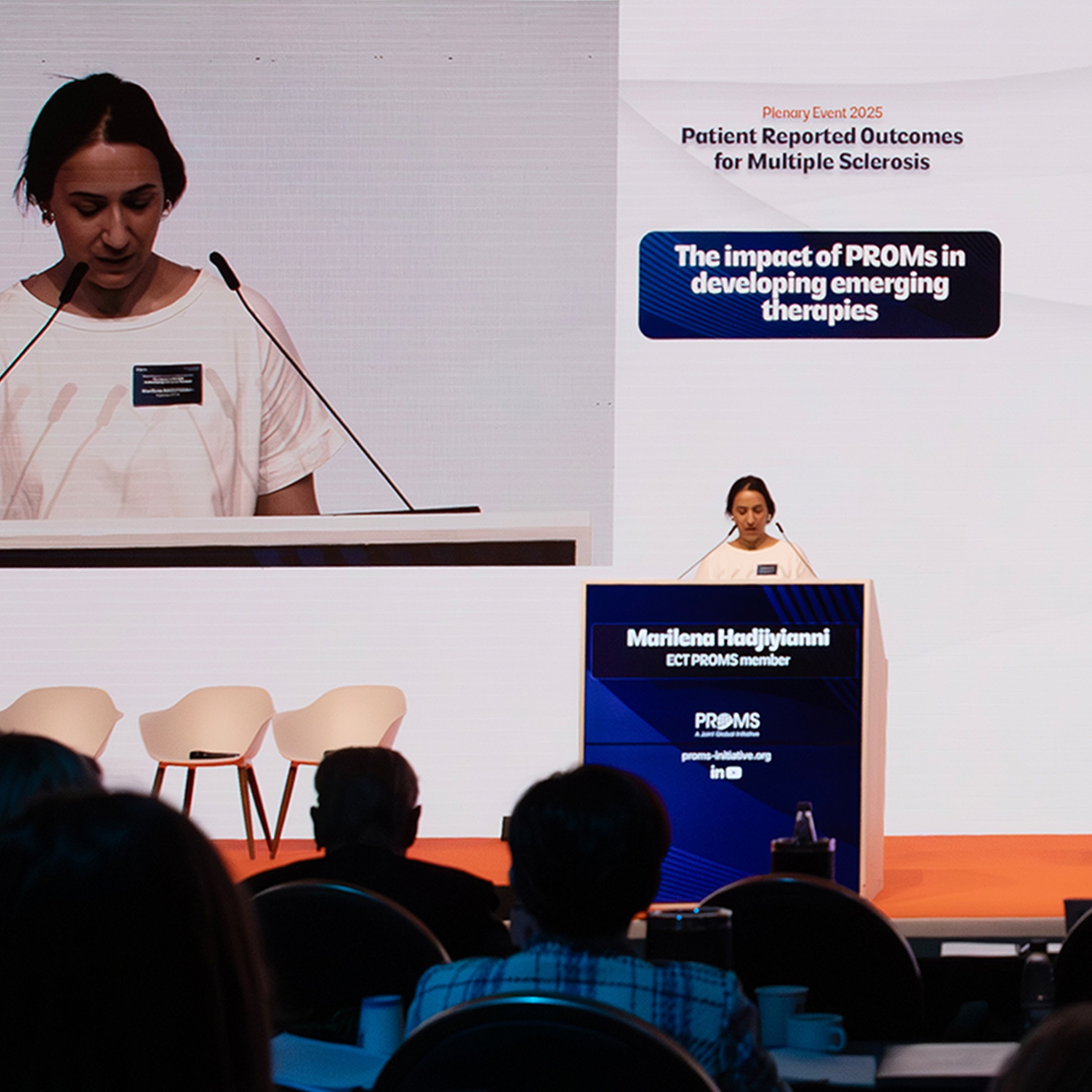
PROMS Initiative shines at ECTRIMS 2024: first survey results and breakthroughs in Patient-Centered MS Care
PROMS Initiative made a significant impact by presenting the first results from its global survey.
ECTRIMS remains a pivotal platform where the latest advancements in MS research and clinical practice are discussed, and this year, the PROMS Initiative took center stage, highlighting the importance of Patient-Reported Outcomes (PROs) in the future of MS care.

Measuring what matters to people with MS
A meeting of the Global PROMS Initiative – Placing all people with MS at the centre
In November 2023, as members of the PROMS Engagement Coordination Team[1], we travelled from across the globe to Baveno, Italy, to discuss the important topic of how patient reported outcomes can help with “Bridging the gap between clinical research and care”.
PROs are increasingly being used across research and healthcare for all conditions – not just MS. We believe that it is important that people with lived experience are at the heart of developing and deciding on which PROs and PROMs are used, so that the outcomes of research are meaningful to those lived experiences.
[1] Zaratin, P., Vermersch, P., Amato, M. P., Brichetto, G., Coetzee, T., Cutter, G., … & Groups, P. I. W. (2022). The agenda of the global patient reported outcomes for multiple sclerosis (PROMS) initiative: Progresses and open questions. Multiple Sclerosis and Related Disorders, 61, 103757.

PROMS Plenary 2023
The PROMS Initiative gathered once again for its annual Plenary Event in Baveno (IT) on Wednesday 8th of November, as a side event of the 31st European Charcot Foundation annual meeting.
The event was first and foremost a great opportunity to confirm the need of a renewed concept of value that needs to be applied from clinical research to care, one that provides content of validity through a humanistic process that makes the experiential knowledge of people living the disease scientifically meaningful for all the stakeholders.
MULTI-ACT ECT is vital to achieve a representative patients’ engagement.
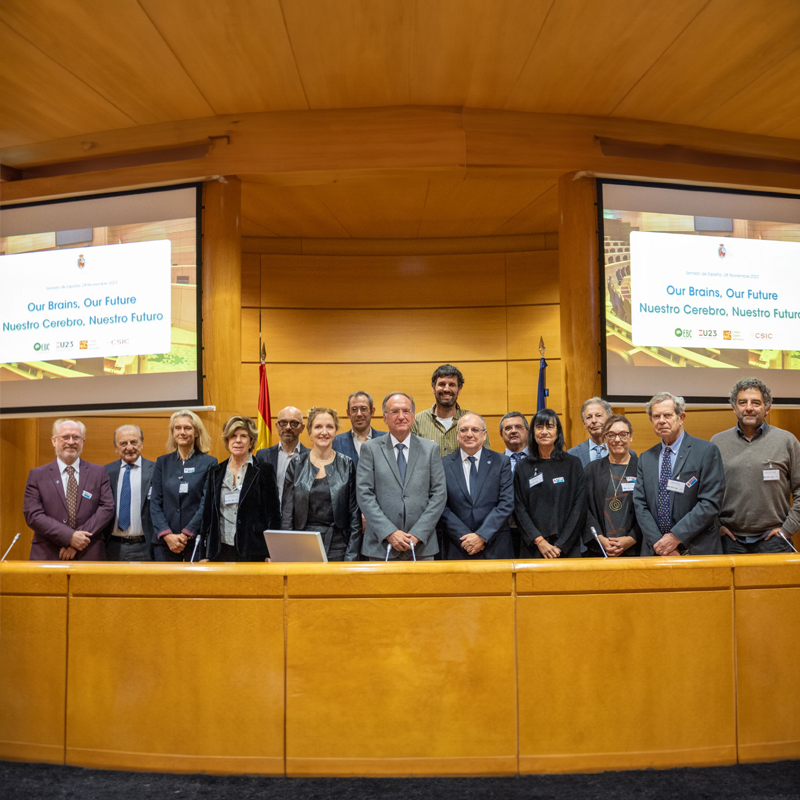
Our Brains, Our Future: the value of brain research – from basic to clinical – to improve patient outcomes in Europe
On November 28th, the PROMS initiative had the privilege to participate in the symposium “Our Brains, Our Future: the value of brain research – from basic to clinical – to improve patient outcomes in Europe”, a key stakeholder meeting co-organised by the European Brain Council in partnership with the Spanish Brain Council (Consejo Español del Cerebro) and the Spanish National Research Council (CSIC), under responsibility of the Spanish Presidency of the Council of the EU.
The WHO framework for the meaningful engagement of people living with NCDs, mental health, and neurological conditions
Last month, the World Health Organization (WHO) has released a new framework for the meaningful engagement of people living with noncommunicable diseases (NCDs), mental health, and neurological conditions.
The WHO framework for meaningful engagement aims to use a rights-based approach to address health inequities and achieve health for all. The framework outlines the vision and pathway to involving individuals with lived experience in co-creating relevant policies, programmes and services, i.e. what matters to them, and sees meaningful engagement as a way to improve health outcomes.
Limitations of Patient Reported Outcomes: Who Tells the Truth?
Important post highlighting the challenge to extract objective and clinically reliable information from Patient Reported Outcome (PRO) and experience measures (PREMs)
As members of the PROMS Initiative we acknowledge the challenge.
Patient reported outcome assessment must be inclusive and equitable
To understand how Patient Reported Outcomes should be more focused on equity and inclusivity, check out the recent paper from our previous key-note speaker (Dr. Samantha Cruz Rivera) and her team at the Centre for Patient Reported Outcomes Research (CPROR) of the University of Birmingham.

PROMS at ECTRIMS 2022
38th Congress of the European Committee for Treatment and Research in Multiple Sclerosis
26-28 October 2022
Is the experience of patients with MS used to influence health policies and decision made in health system?
ECTRIMS is the world’s largest professional organisation dedicated to the understanding & treatment of #MS.
The #PROMSinitiative is thrilled to announce that it will be featured in the 2022 edition of its annual international conference devoted to basic and clinical research & care for people #LivingwithMS […]